Goals and specifications
Translate product intent into a shared set of goals, requirements and technical specifications.

Capabilities
From the transducer to the complete product: acoustics, electronics, mechanics and DSP, developed together around the experience you want to create.
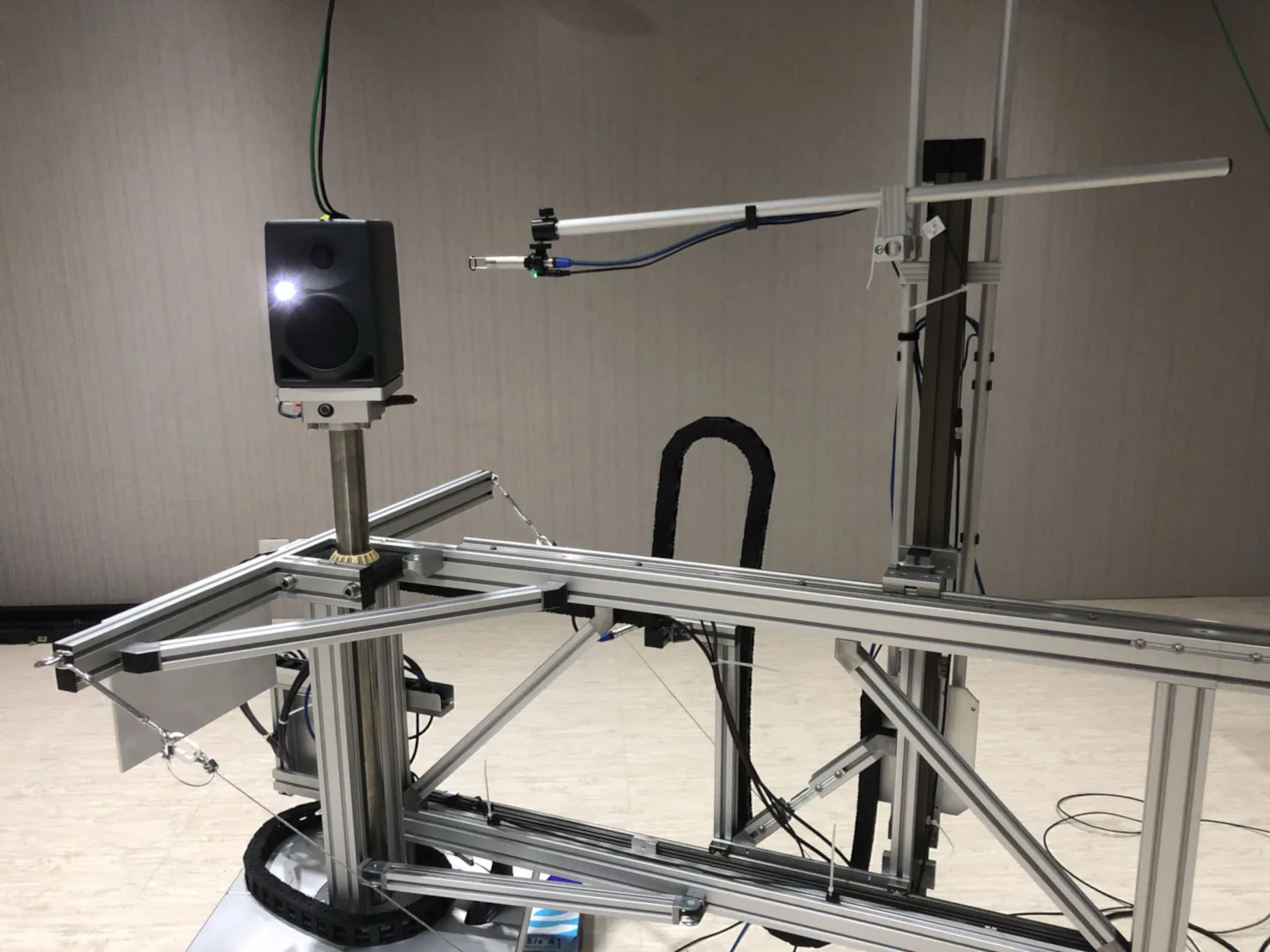
An automated rig captures response across listening angles, not only directly in front of the loudspeaker.
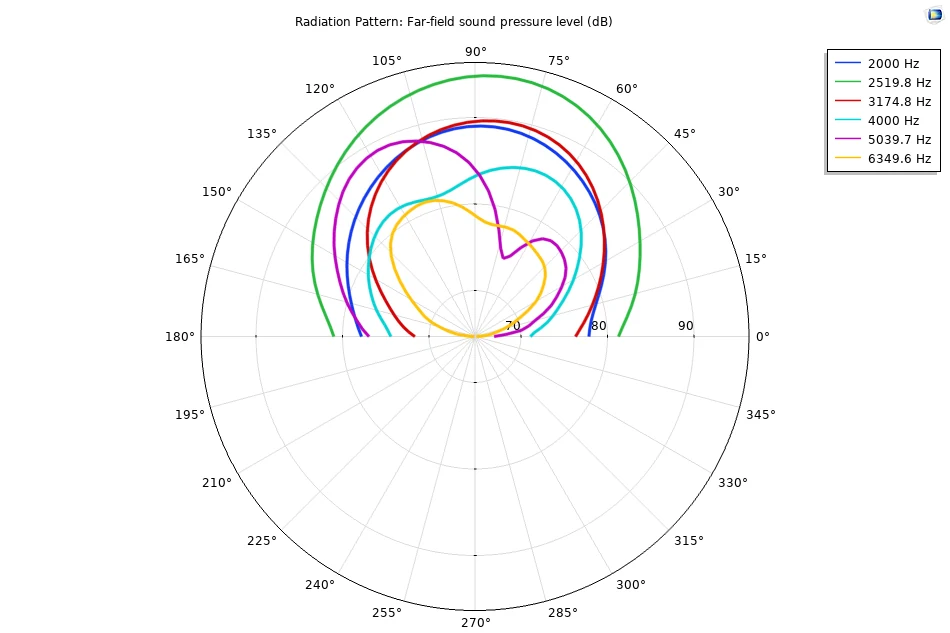
Each curve shows a frequency's response by angle. The differences help evaluate coverage and acoustic concepts.
Inspect the plot (opens in a new tab)Selected engineering views from different contexts. These images do not document a single customer program or a shared measurement result.
Simulation & design
Simulation makes interactions visible before a build. Measurement then tests the assumptions against the physical product.
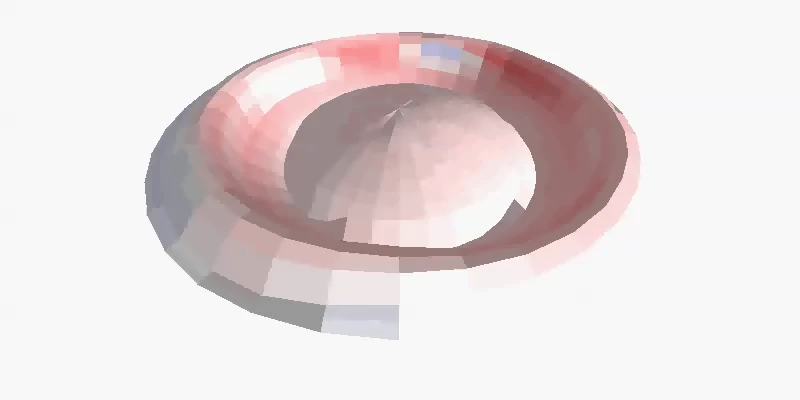
Suspension, motor, thermal and mechanical studies connect component design to excursion, distortion and reliability.
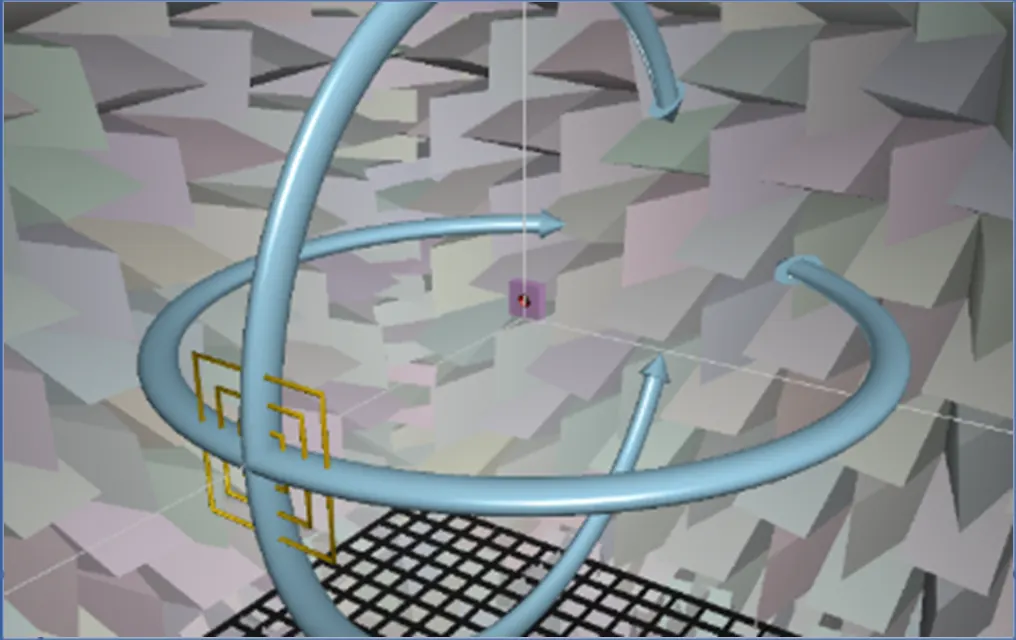
Wave radiation and enclosure studies inform geometry, ports, passive radiators, crossover design and DSP tuning.
From question to evidence
Agree what needs to be learned, then connect models, prototypes and tests to that decision.
Define the product targets and critical risks. Compare concepts with explicit models and assumptions.
Concept comparison · Models & assumptionsUse proof-of-concept and proof-of-architecture builds to measure response, test interactions and refine the design.
Prototype measurements · Tuning recordReview product-specific functional and reliability checks. Record the findings and what the next build must prove.
Verification findings · Next-build recommendationMap EMC and safety requirements early, then coordinate independent laboratory work where the program requires it. Test scope and acceptance criteria are agreed for each product.
Methods & disciplines
Explore the development methods and practical outputs behind each discipline.
The intended experience, technical targets, responsibilities and learning plan are made visible before detailed execution begins.
Translate product intent into a shared set of goals, requirements and technical specifications.
Structure the work, identify decision owners and keep cross-domain interfaces visible.
Build the schedule, assess and mitigate risk, form the team and establish information sharing.
Identify where structured experiments can replace assumption with measurable evidence.
Goals & specifications · Work-breakdown structure · Stakeholder map · Schedule, risk & DoE plan
Simulation, objective measurement and subjective evaluation connect the industrial-design concept to the final system response.
Compare industrial-design concepts through acoustic simulation, objective response including directivity, and subjective evaluation.
Model wave radiation, enclosures, ports, passive radiators, system THD, excursion and nonlinear behavior.
Develop and optimize crossovers, filters and DSP tuning as part of the complete acoustic architecture.
Use full- and half-space anechoic measurement plus nonlinear and thermal characterization to close the design loop.
Concept comparison · Models and assumptions · Objective response & directivity review · Tuning record
Component work spans micro to professional formats and connects motor, suspension, waveguide, thermal and mechanical behavior.
Micro, headphone, tactile, compact, full-range, coaxial, hi-fi, low-profile, compression and professional woofer formats.
Electromagnetic saturation, motor inductance, suspension optimization and demagnetization-temperature analysis.
Waveguide, structural stress and tinsel-lead simulation connect component decisions to real operating conditions.
Balance the driver, enclosure, amplifier and DSP so component capability translates into system performance.
Motor & suspension studies · Thermal and mechanical findings · Component characterization · System-integration recommendation
Signal path, amplification, power, battery and RF decisions are developed as one integrated product architecture.
Discrete, Class AB, Class D, digital Class D and Class G amplification with driver, DSP and amplifier integration.
Mains supply topologies, charging, battery management, protection and multi-cell lithium architectures.
Requirements and constraints, proposals, simulation, fabrication, measurement, tuning, verification and validation.
Schematic and PCB design, circuit simulation, version-controlled libraries and data analysis support repeatable decisions.
Architecture proposal · Schematic & PCB design package · Simulation and measurement record · Validation decision
Structure, thermal behavior, optics, materials and manufacturing process are evaluated together around the product intent.
Thermal and airflow analysis, vibration, deformation and stress, drop and shock, plus optical illumination studies.
Injection-molding simulation, deformation analysis and CT-based failure analysis support design learning.
Wood, die-cast or extruded aluminium, injection or extruded plastic and waterproof cabinet architectures.
Transfer processes, metallic paint, anodizing, fabric wrapping, stitching, etching, stamping and extrusion.
Thermal, flow & stress studies · Molding or failure analysis · Material & finish decision · Reliability evidence
DSP tuning, psychoacoustics, voice processing and application layers connect the acoustic system to the product experience.
Configure and tune the signal path around the acoustic system, product constraints and intended listening experience.
Develop flexible, multi-channel processing chains around product context, acoustic behavior and the intended listening experience.
Integrate voice processing and speech-pickup behavior with acoustics, DSP, mechanics and the product context.
Integrate app software alongside DSP, signal processing and voice processing.
Signal-flow definition · DSP tuning configuration · Multi-channel processing build · Integration notes
PoC and PoA builds connect design, simulation, verification, data analysis and documented learning.
Set goals and specifications, assess risk and identify the design-of-experiments needed to answer critical questions.
Use PoC and PoA builds with status tracking, design and simulation.
Connect verification and validation to structured data collection and performance analysis.
Report prototype performance, retain technical documentation, conclude and capture lessons learned.
PoC / PoA build record · Collected data and analysis · Performance report · Technical documentation & lessons learned
Representative methods and outputs. Scope, format and responsibilities are agreed for each work package.
An engineering conversation
Tell us the use case, the critical constraint and what you already know. We can start there.